
33 Dhekr Sound Wellness · First Post
Why I call myself a facilitator
Not a healer. Not a practitioner performing a treatment. A facilitator—someone who creates space, first in his own life, and then holds that space steady enough for someone else to rest in it.
I want to start our blog by being clear about a word, because the word shapes what you should expect when you sit down with me.
As I have studied sound wellness more deeply, I have moved away from calling this work sound therapy or a sound bath. Those terms have become trendy, and trendy can get careless. Bowls get bought, a session gets posted, and words like intuition and spirit get used without a real understanding of what is being done—or why. I do not think it is fair to build on people's ignorance. I would rather be plain about what this is, and what it is not.
So I choose facilitator. On purpose.
I am not here to heal you or fix you
A healer, to most ears, sounds like someone who does the healing to you. A practitioner can sound like someone performing a treatment on you. That is not my role, and I will not pretend that it is.
I am not diagnosing you. My training—in sound wellness, in trauma-informed coaching, and as someone trained in Mental Health First Aid—taught me the opposite: do not try to diagnose, do not judge, and do not make yourself the answer. My work is to be a non-judgmental, safe space, and to facilitate room for your own nervous system to do what it already knows how to do: slow down, breathe, rest, relax, regulate, and reset.
That difference matters. You are not broken material for me to work on. You are a person who may be carrying a lot—heavy, overwhelmed, tired in a way sleep does not always touch—and who deserves a space that does not add pressure to perform, explain, or be fixed.
Space has to be created in your own chaos first
Here is the part a lot of people skip, and I will say it plainly: I do not believe you can fairly offer somebody else space if you are not creating space for yourself, in your own chaos, first.
A facilitator has to do that religiously. Not once. Not when life gets quiet. In the chaos, as it is. In order to offer anybody space, it has to first be created within and for yourself.
As that space strengthens and fortifies in you, it expands—until there is enough of it for someone else to find safety in.
When you practice it that way, something changes. It stops being something you do for someone else. It becomes second nature, shaping who you are and how you move. You are not performing calm for a client. You are sitting in a space you already live in, and they get to borrow its steadiness for a little while.
Without that daily ministry, I do not think the title means much. With it, facilitation is honest work.
These are vessels, and I keep a daily relationship with each one
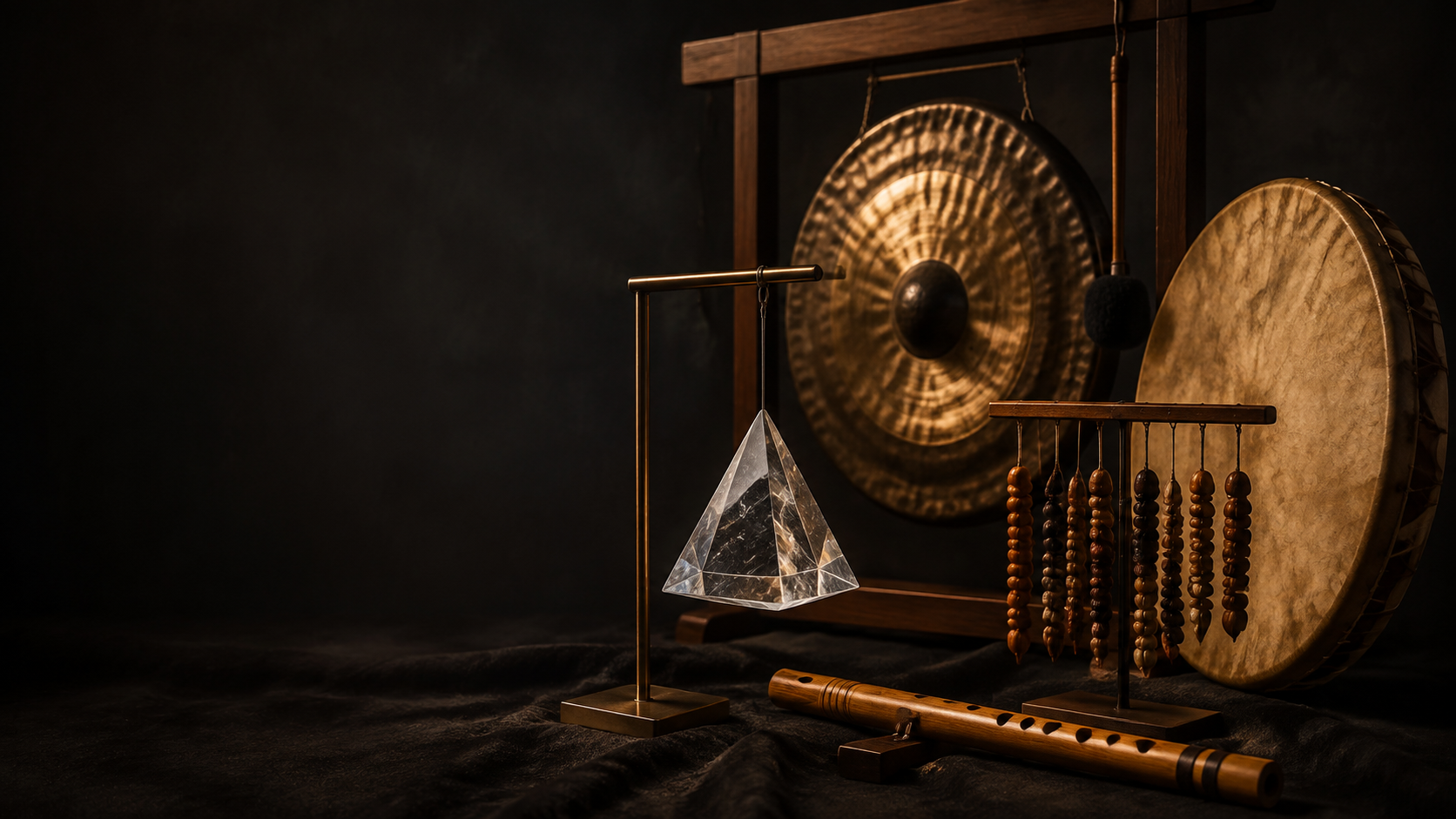
People call them instruments. I call them vessels, because my intention moves through them in service to other people, and my life force is what gives life to the frequency they carry.
A vessel like that cannot be treated like equipment you only pick up when you are booked, or when you need content for social media. This has to be a daily relationship—the way you would call your best friend, your brother, or your sister to see how they are doing, to communicate, to bond, and to build with them. That is how I approach each one of my vessels, every day.
That daily care is part of the lifestyle. It is part of the ministry. It is also why I value the Gong Bath so much: it asks for only one instrument. Light, mobile, honest work. You do not need a room full of instruments to facilitate a real session. You need a relationship with the one in front of you, and a space inside yourself that is already tended.
What a session with me actually feels like
We start with breath. I like to offer five minutes of breathwork before the sound begins, because breath and sound go hand in hand. The breath settles you; the sound carries you further—toward that quieter, theta-like state where the body is not bracing quite so hard.
Whether you choose a short taster or a longer session, the heart of it is the same: personal first, no judgment, and room to simply be heavy, tired, or overwhelmed without having to fix it in the room.
33 Dhekr offers nonclinical sound wellness. Sessions are for relaxation and nervous-system support and are not medical treatment, therapy, or diagnosis. If you are in crisis, please reach out to a trusted professional or emergency support in your area.
Thank you for reading the first post. More to come—in plain language, from practice, not performance.
— Musa