← All writing
33 Dhekr Sound Wellness · Detroit

“I am the science.” A walking testimony — with the research to back it up

Before there was a study to cite, there was a life to save — his own. Musa Abdullah Shaheed was having grand mal seizures three to five times a week, and he had to heal himself: changing his diet, learning to breathe correctly and balance his own breathing, Qur'an recitation and dhikr, box breathing and other breathwork, energy release, stillness, and meditation. Those same practices then carried him through two attempted murders, two years on house arrest fighting for custody of his daughter, and injuries that would have broken most people. That testimony comes first on this page. The peer-reviewed research below offers context for selected sound-based outcomes. It does not test Musa’s full personal practice or establish that sound wellness, breathwork, dhikr, or diet treats seizures, trauma, or injuries.

3–5×a week — the grand mal seizures Musa was living with before he rebuilt his health through breath, recitation, and stillness
14quantitative studies in the Lin, Yang & Wang 2025 systematic review of Tibetan singing bowl intervention in adults
62adults in the Goldsby UC San Diego study — one 60-minute singing bowl session, measured right before and after
19clinical studies in the broader Cai et al. 2025 review, across 8 countries (2008–2024)

How to read this: Musa’s story is personal testimony. The studies below examined different sound interventions and measured short-term outcomes in other participants; they do not establish the cause of Musa’s health changes or validate his full combination of practices.

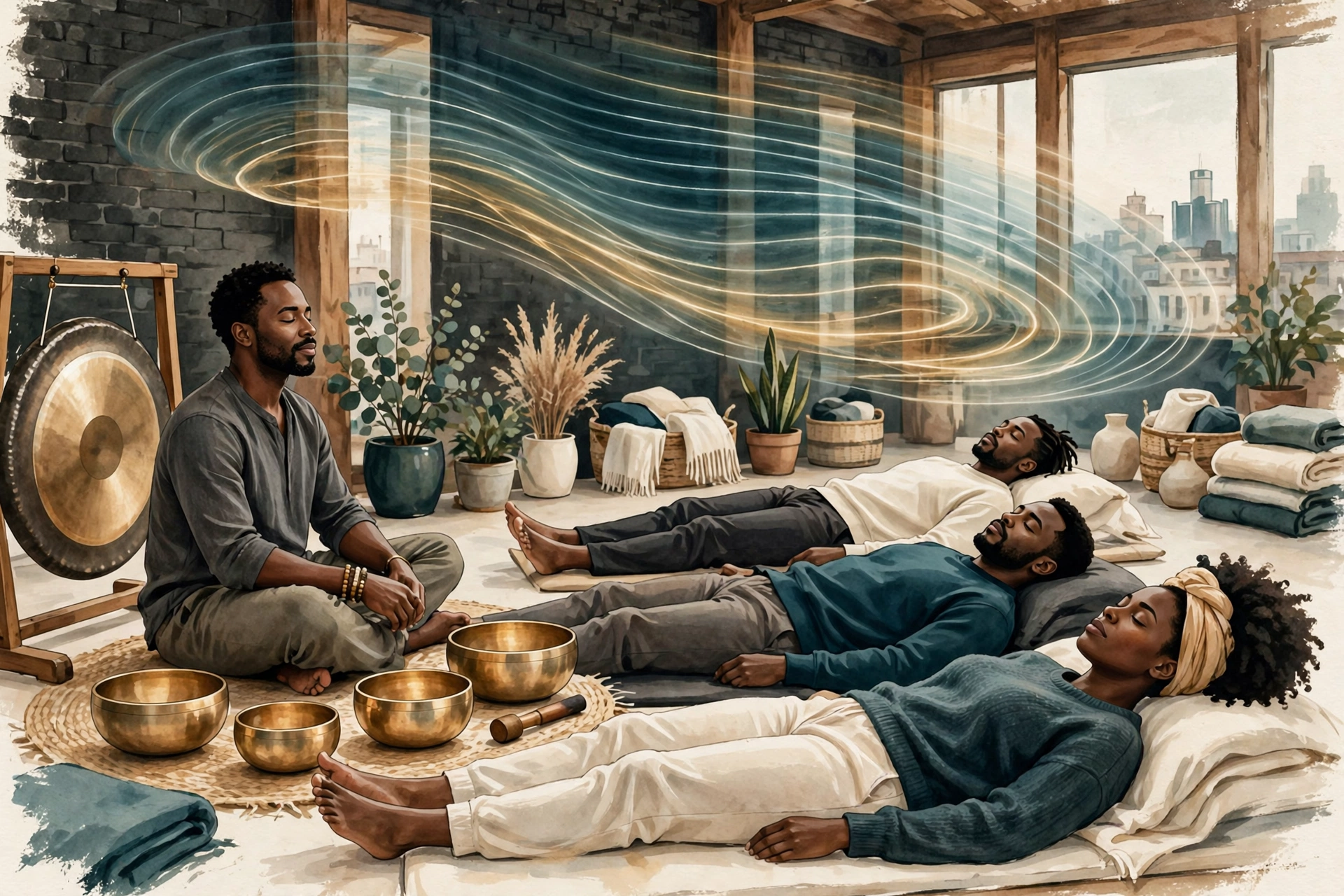
Painted illustration of a sound wellness session: a facilitator seated by a gong and singing bowls while three people rest on mats, sound rippling through the room above them
First, the testimony

“I'm a walking testimony. I am the science.”

In Musa's own account — the reason 33 Dhekr exists, and the foundation everything else on this page stands on.

I had to heal myself from seizures. I was having grand mal seizures three to five times a week. I had to change my diet, learn how to breathe correctly and balance my own breathing — and one of the things I used was Qur'anic recitation and dhikr.

It grew from there: from Qur'anic recitation and dhikr and controlled breathing into actual breathwork — box breathing and different forms of breathwork — energy release and energy work, stillness and meditation, to combat these things, just to get my health.

And after I got my health, I had to fight two attempted murders back to back — two years on house arrest while fighting for custody to be able to see my daughter. I had to defend myself in front of my home while my daughter was inside asleep, while somebody tried to rob me and pull a gun on me. I wrestled the gun away — it was their gun, not mine — and they wound up getting shot four times in me defending myself.

Right behind that, a car accident gave me a 76% rotator cuff tear in my left arm and three herniated discs in my back — my C4, C5, and C6. Then right behind that, another car accident hit me again: two more herniated discs and my shoulder re-injured. That's how I learned it was seat belts, not proper physical therapy — and yet I maintained my ministry of alignment.

These were the things that kept me sane, aligned, and at peace, with a sense of humility, while embodying these practices around me. I'm bringing science in to back up my own testimony.

1

Healing himself

Diet. Correct, balanced breathing. Qur'an recitation and dhikr. Box breathing and other breathwork. Energy release and energy work. Stillness and meditation — practised daily, to get his health back from seizures three to five times a week.

2

Held through the fight

Two attempted murders back to back. Two years on house arrest fighting for custody of his daughter. Defending his home while she slept inside. The practices held — sane, aligned, and at peace, with humility.

3

Alignment through injury

A 76% rotator cuff tear and herniated discs at C4, C5, and C6 — then a second accident, two more herniated discs, and the shoulder re-injured. Still maintaining his ministry of alignment.

“I'm a walking testimony. I'm bringing science in to back up my own testimony… I am the science.”
— Musa Abdullah Shaheed, founder and facilitator, 33 Dhekr Sound Wellness
The space sound creates

Decompression is what the space is for

A sound wellness session is a meeting place: a space set apart where you can integrate, reset your alignment, and let what you've been carrying lower. People don't walk in carrying a diagnosis — they walk in carrying a state. Below are states people may bring, the kind of space a session offers, and related outcomes measured in sound-based studies.

Anxiety

The racing, braced feeling the session gives room to settle. In two controlled studies summarized in the 14-study review, state anxiety was lower than control at p<0.001; each reported a large effect size (Cohen's d = 1.51 and 2.18).

Measured directly in studies

Tension

The tight body — jaw, shoulders, chest. Goldsby et al. measured tension falling from 1.26 to 0.14 right after one session (p<0.001), the single largest change in that study.

Measured directly in studies

Overwhelm

Too much coming in at once, no room to sort it. In the studies, the closest measures — distress and confusion — fell after sessions, similar to some experiences people describe when overwhelm starts to lift.

Backed by distress & confusion measures

Burnout

Depletion from carrying too much for too long. The one burnout-specific study found: 80 nurses, 7 gong meditation sessions during COVID-19, with significant improvements in perceived stress and occupational burnout versus control.

One gong study · nurses only

Pressure

The constant push of demands with nowhere to set them down. Studies track this as perceived stress: it fell after sessions in single-group studies — for example, distress 5.3 → 2.4 (p=0.0005) in a small cancer-patient study.

Tracked as perceived stress / distress

Survival mode

Living braced, never fully off duty. Some studies found lower heart rate or higher heart-rate variability after sessions. These measures can be consistent with relaxation-related changes, but they do not directly measure a person's sense of being in survival mode.

Backed by heart rate & HRV measures

Trauma

What the body still carries. In the study with 20 Ukrainian refugees living with PTSD, bowl massage combined with visualisation and breathing lifted well-being — psychological health up 24%, vitality up 19% — the space supporting people carrying the heaviest weight.

Well-being up in PTSD study · n=20

Low mood

The heaviness underneath the rest. Depressive symptoms fell in most controlled studies in the review, with effect sizes from 0.5 to 1.8 — related outcomes measured in some studies.

Measured directly in studies

Integration & realignment

What the space is ultimately for: time to put yourself back together and return to your alignment. Studies gesture at this as well-being — Goldsby's spiritual well-being rose 2.85 → 3.64 (p<0.001) in the same hour tension fell.

Tracked as well-being
“Tibetan singing bowl meditation may be a feasible low-cost low technology intervention for reducing feelings of tension, anxiety, and depression, and increasing spiritual well-being.”
— Goldsby et al., authors' conclusion, Journal of Evidence-Based Complementary & Alternative Medicine, 2017
Research related to the testimony

The 2025 review of 14 studies, outcome by outcome

Lin, Yang & Wang, “Effects of Tibetan Singing Bowl Intervention on Psychological and Physiological Health in Adults: A Systematic Review,” Healthcare 2025, 13(16), 2002. Fourteen quantitative studies (2000 – March 2025), adults 18+, appraised with GRADE certainty ratings — the review's own confidence score for each outcome. Designs: 3 parallel-group randomized controlled trials, 2 randomized crossover trials, 4 controlled quasi-experimental studies, and 5 single-group pre–post studies. This is research context, not a test of Musa's personal experience or the exact sessions offered by 33 Dhekr.

OutcomeWhat the 14 studies foundReview's certainty (GRADE)
Anxiety↓ Lower — State Anxiety Inventory scores lower than control in both controlled studies, p<0.001. Large effects in two small controlled studies: Cohen's d = 1.51 (Hasani 2025, patients awaiting angiography) and d = 2.18 (Rio-Alamos 2023).Moderate
Depressive symptoms↓ Lower — Controlled-study effect sizes 0.5–1.8. Live bowl music with guided imagery reduced depression at p<0.001 (Stamou 2016, n=24).Low to moderate
Stress / tension↓ Lower right after — Distress 5.3 → 2.4, p=0.0005 (Bidin 2016, n=12, six sessions); tension 1.26 → 0.14, p<0.001 (Goldsby 2017) — the decompression, measured.Single-group studies
Well-being↑ Higher — In the PTSD-refugee study (Pozmogova 2023, n=20): +24% psychological health, +19% vitality, p<0.05 versus control. Goldsby: spiritual well-being 2.85 → 3.64, p<0.001.Low
Quality of life↑ Higher — Controlled research found improvements in vitality and psychological health after bowl sessions.Low
Heart-rate variability↑ Higher — 3 of 4 controlled studies found significant increases (RMSSD / HF, p<0.05), interpreted as more parasympathetic — relaxation-side — activity.Low to moderate
Heart rate↓ Lower — Greater reduction than controls in 2 quasi-experimental studies (p<0.05); single sessions reduced heart rate at p=0.003 (Landry 2014) and p=0.009.Low
Brainwaves (EEG)↑ Slow waves up — In one study (Kim & Choi 2023, n=17, 5-minute session): delta +135.2% (p=0.001), theta +117.1% (p=0.002) — the slow waves linked to deep rest and the theta state breath and sound open up — while alpha/beta/gamma fell.Low to moderate

The review’s summary: Across the included studies, authors reported generally favorable changes in anxiety, depressive symptoms, well-being, quality of life, and selected heart measures, while noting that the evidence remains limited.

How this relates to the testimony: the review describes short-term outcomes from different interventions and participants. Similarity to Musa’s account is context, not proof that the practices caused his health changes.

A widely cited single study

One hour, 62 people: what changed in the room

Goldsby, Goldsby, McWalters & Mills (2017), UC San Diego — Journal of Evidence-Based Complementary & Alternative Medicine 22(3), 401–406. Sixty-two adults (ages 21–77) lay down for about 60 minutes while Tibetan bowls were played roughly 95% of the time, with crystal bowls, gongs, tingshas, bells, and didgeridoo making up the rest. Mood, tension, and well-being were measured immediately before and after (POMS-SF, HADS, FACIT-SP). Lower is better on every measure below.

Before → after a single 60-minute session

Mean scores, n=62. All changes p<0.001 except depressed mood (p=.002). Effect sizes were large (η² .42–.54 for tension, anger, confusion, fatigue, anxiety).

Before the sessionAfter the session
Tension−89%
1.26 → 0.14
Anger−94%
0.85 → 0.05
Confusion−73%
1.10 → 0.30
Fatigue−75%
1.65 → 0.42
Anxiety (HADS)−60%
1.11 → 0.44
Depressed mood (HADS)−32%
0.62 → 0.42 — the smallest change in the study

Moving the other way, spiritual well-being rose 2.85 → 3.64 (p<0.001) and faith rose 3.18 → 3.46 (p=.005). Vigor decreased (1.97 → 1.48, p=.002) — people left quieter, not energised. First-timers benefited most: participants new to bowl meditation (n=26) had a significantly greater tension drop than experienced participants (1.61 → 0.32, p<.001). Among the 29 participants reporting pain, ages 40–59 saw the largest pain reduction (2.00 → 0.79).

Why this study matters here: 62 people, one hour in the space sound creates — and tension, anger, fatigue, anxiety, and depressed mood all fell while spiritual well-being rose. First-timers felt it most. That is the room Musa holds at 33 Dhekr, measured: an hour set apart to decompress, integrate, and reset your alignment.

Study by study

The studies inside the reviews

Filter by what you came in carrying. Each study below is part of the backup — different people, different rooms, the same direction: the space sound creates supports decompression.

Rio-Alamos et al. · 2023 · RCT · n=50

The strongest controlled test

Adults selected for high state anxiety had one 50-minute session: Tibetan bowls (n=16) vs progressive muscle relaxation (n=19) vs waitlist (n=15). Bowls produced a greater anxiety reduction than both, plus a greater rise in heart-rate variability and a drop in EEG alpha power (p<0.001).

Context: adults selected for high state anxiety, one 50-minute session. The strongest controlled backing for the acute relaxation response people feel in the room.

AnxietyHRVRandomised
Hasani et al. · 2025 · Controlled · n=60

Ten minutes before a heart procedure

Patients awaiting coronary angiography held a singing bowl on the palm for 10 minutes versus usual care. Anxiety fell significantly versus control (p<0.001), with a large effect size (Cohen's d = 1.51).

Context: ten minutes, in one of life's high-pressure moments — waiting on a heart procedure — and anxiety fell.

AnxietyPressure moments
Landry · 2014 · Randomised crossover · n=51

Twelve minutes, calmer body signals

Twelve minutes of Himalayan bowl vs twelve minutes of silence, each followed by directed relaxation. Systolic blood pressure and heart rate fell more with the bowl (p=.044 and p=.003), and mood eased in the room as people rested in the sound.

Context: a short, 12-minute session — the body signals moved first: blood pressure and heart rate down with the bowl in the room.

Blood pressureHeart rateBody signals
Kim & Choi · 2023 · n=17

Five minutes, slower brainwaves

After a 5-minute bowl session, delta brainwave activity rose +135.2% (p=0.001) and theta rose +117.1% (p=0.002), while alpha, beta, and gamma decreased — a shift toward the slow-wave patterns of deep rest.

Context: a single 5-minute session — and the brain already shifting toward deep rest.

EEGDelta / theta
Bidin et al. · 2016 · n=12

Distress, halved over six sessions

Cancer patients received six 60-minute bowl sessions over three months. Distress fell from 5.3 to 2.4 (p=0.0005), heart rate decreased, and heart-rate variability increased.

Context: 12 people, six sessions over three months — distress cut by more than half.

DistressRepeated sessions
Oguy et al. · 2018 · n=33

How long does it last? About a day, in this study

Adults with stress symptoms received vibroacoustic bowl massage. Anxiety fell sharply right after (Zung scale 48.2 → 35.6; state anxiety 39.8 → 26.3, p<0.05).

Context: the relief was strongest right after the session — which is why this is a practice you return to, the way Musa returns to breath, recitation, and stillness daily.

Anxiety24-hour follow-up
Wepner et al. · 2008 · RCT · n=54

Pain down over six sessions

People with chronic back pain received bowl sessions over four weeks — six sessions in the space. Pain intensity and heart rate decreased (p<0.05), and mood lifted across the sessions.

Context: six sessions over four weeks with people living with chronic back pain — pain and heart rate moving down together.

Chronic painRepeated sessions
Hsieh et al. · 2022 · Gong meditation · n=80

The one burnout study — and it's the gong

Eighty nurses in Taiwan during COVID-19 were randomised to seven 50–60 minute gong meditation sessions or no intervention (79 completed). Perceived stress and occupational burnout improved significantly versus control: personal burnout −6.53, work-related −5.85, client-related −3.98.

Context: the burnout study in this research — and it is the gong, Musa's own instrument, played for nurses carrying pandemic pressure.

BurnoutGongStress
Pozmogova et al. · 2023 · n=20

The only PTSD study in the reviews

Twenty Ukrainian refugees with PTSD in the Netherlands received Tibetan bowl massage combined with colour visualisation and breathing, 15–20 minutes twice weekly for six weeks, versus stress management only. Well-being improved (p<0.05): psychological health +24%, vitality +19%. The control group did not change.

Context: bowls together with breathing and visualisation — the same combination Musa lives by: sound, breath, and remembrance working as one practice.

TraumaWell-beingCombined intervention
Ravikumar et al. · 2026 · RCT · n=100 · Preliminary

The newest trial — daily practice, not a weekly bath

One hundred adults in India did 60 minutes of supervised sound-based meditation daily for four weeks (recorded 528-Hz audio with bowls, gongs, bells, tingshas) versus a remote music control. Anxiety, depression, salivary cortisol (−2.54 nmol/L), and systolic blood pressure (−7.62 mmHg) all favoured sound, p<0.001.

Context: 60 minutes of sound-based meditation daily for four weeks — the newest backing for making this a daily practice.

AnxietyCortisolPreliminary
The wider picture

Three reviews, one direction — context for the testimony

The reviews report possible short-term changes in tension, anxiety, mood, and some heart measures. The evidence is preliminary, and the interventions and participants differ from Musa’s personal experience and 33 Dhekr sessions.

What the reviews found

  • Stanhope & Weinstein (2020), the first review, found improvements across distress, affect, anxiety, depression, fatigue, tension, anger, confusion, and body measures like blood pressure and heart rate.
  • Cai et al. (2025) gathered 19 clinical studies from 8 countries; 74% measured mental-health outcomes, and single trials showed anxiety and depression lower than usual care in elderly, Parkinson's, and pre-surgery groups.
  • Lin et al. (2025) reviewed 14 studies and found most reported significant reductions in anxiety and depressive symptoms, improvements in well-being, increases in heart-rate variability, and decreases in heart rate.
  • Lin et al. describe singing bowl sessions as highly acceptable, low-cost, non-invasive, and suitable for community settings — a space ordinary people can actually step into.

How the testimony and the research meet

  • Lived first, measured separately. Musa says these practices helped him. Research studies measured other participants receiving different sound interventions; overlap in reported experiences is not proof of cause.
  • The space is the meeting place. The studies measured participants receiving specific sound interventions. Musa describes his sessions as a meeting place to integrate, reset alignment, and decompress; the research did not evaluate his exact approach.
  • A practice, not a one-time event. Reported changes were often measured right after a session — a reason some participants may choose to return, while longer-term effects remain uncertain.
  • Held with care. At 33 Dhekr, sessions are trauma-informed and nonclinical: you choose how you participate, the volume is held with intention, and the space is made for rest — the same care Musa first had to make for himself, in his own chaos, every day.
In Musa's words

The testimony first — research for context

This is how Musa speaks on it: his story is personal testimony. The studies that follow provide context about sound-based interventions, not clinical proof of his personal experience.

The testimony

“I'm a walking testimony. I was having grand mal seizures three to five times a week, and I had to heal myself — diet, learning to breathe correctly, Qur'an recitation and dhikr, box breathing and breathwork, energy release, stillness, meditation.”

“After I got my health, these practices kept me sane, aligned, and at peace — through two attempted murders, two years on house arrest fighting for custody of my daughter, and injuries to my shoulder and my spine. I maintained my ministry of alignment.”

“Sound creates the space — a meeting place where you can integrate, reset your alignment, and decompress the anxiety, overwhelm, burnout, tension, pressure, survival mode, and trauma you've been carrying.”

The research

In an observational study of 62 adults, several mood and tension scores were lower immediately after a 60-minute sound session, and spiritual well-being scores rose.

A 2025 review of 14 studies found generally favorable short-term changes across several psychological and physiological measures, while emphasizing small samples and varied study designs.

In one preliminary study, 80 nurses received seven gong meditation sessions; perceived stress and occupational burnout improved versus a no-intervention control. The study did not evaluate 33 Dhekr sessions.

Sources

Research sources and study details

Sources reviewed 15 November 2026. Individual studies marked “via Lin et al.” were checked against that review’s tables. Evidence is preliminary and does not establish medical treatment effects for 33 Dhekr sessions.

  1. Lin, F.-W., Yang, Y.-H. & Wang, J.-Y. (2025). Effects of Tibetan Singing Bowl Intervention on Psychological and Physiological Health in Adults: A Systematic Review. Healthcare 13(16), 2002. DOI: 10.3390/healthcare13162002. pmc.ncbi.nlm.nih.gov/articles/PMC12385955
  2. Goldsby, T.L., Goldsby, M.E., McWalters, M. & Mills, P.J. (2017; online 2016). Effects of Singing Bowl Sound Meditation on Mood, Tension, and Well-being: An Observational Study. Journal of Evidence-Based Complementary & Alternative Medicine 22(3), 401–406. DOI: 10.1177/2156587216668109. pmc.ncbi.nlm.nih.gov/articles/PMC5871151
  3. Cai, Y. et al. (2025). Therapeutic effects of singing bowls: A systematic review of clinical studies. Integrative Medicine Research 14(2), 101144. DOI: 10.1016/j.imr.2025.101144. pmc.ncbi.nlm.nih.gov/articles/PMC12063014
  4. Stanhope, J. & Weinstein, P. (2020). The human health effects of singing bowls: A systematic review. Complementary Therapies in Medicine 51, 102412. DOI: 10.1016/j.ctim.2020.102412. pubmed.ncbi.nlm.nih.gov/32507429
  5. Rio-Alamos, C. et al. (2023). Tibetan Singing Bowl sound meditation for anxiety. European Journal of Investigation in Health, Psychology and Education 13, 317–330. DOI: 10.3390/ejihpe13020024. mdpi.com/2254-9625/13/2/24
  6. Hsieh, H.-F., Huang, Y.-T., Ma, S.-C. & Wang, Y.-W. (2022). Occupational burnout and stress of nurses in Taiwan regarding COVID-19: An intervention with gong meditation. Journal of Nursing Management 30(8), 3909–3917. DOI: 10.1111/jonm.13653. pmc.ncbi.nlm.nih.gov/articles/PMC9115189
  7. Ravikumar, H. & Sathyanarayanan, S. (2026). Effects of a Sound-Based Meditative Intervention on Anxiety, Depression, Salivary Cortisol Levels, and Blood Pressure: A Randomized Controlled Trial. Cureus 18(9), e115693. PMID 42694510 — preliminary RCT; short-term findings need replication. pmc.ncbi.nlm.nih.gov/articles/PMC13539022
  8. Landry (2014), Hasani et al. (2025), Pozmogova et al. (2023), Oguy et al. (2018), Bidin et al. (2016), Wepner et al. (2008), Kim & Choi (2023), Stamou (2016) — as summarised in Lin et al. (source 1) Tables 1–3 and Cai et al. (source 3).